TechBio UK 2026: connecting people and datasets
The technology set to transform data in life sciences
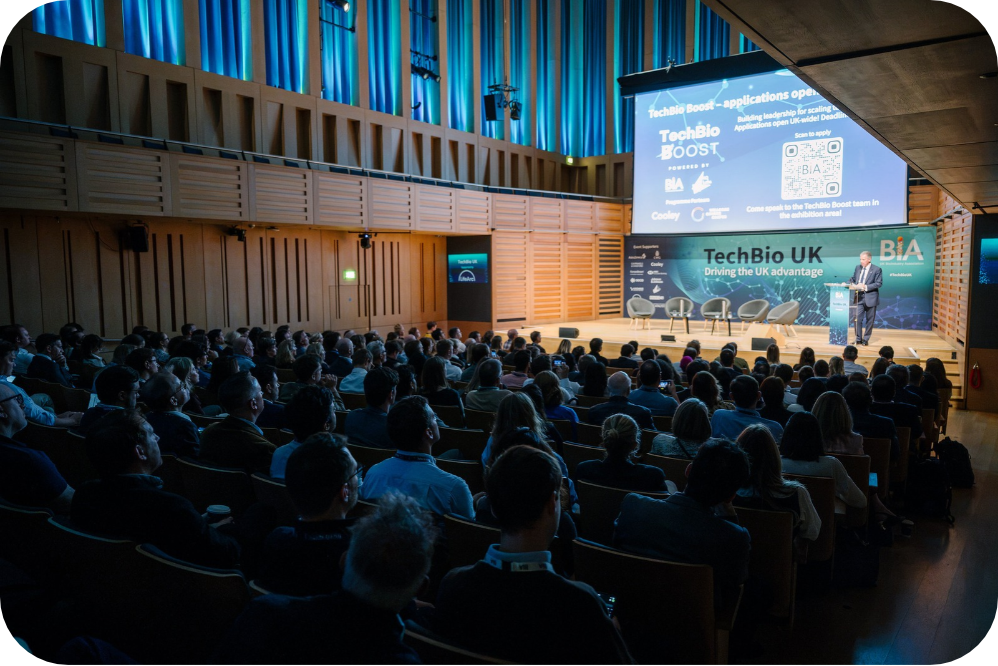
Chris Molloy, CEO of BIA, presenting at TechBio UK 2026

Ethan Almond
Content and Communications Executive, BIA
Entering the spacious Kings Place in North London, it’s hard to ignore the early morning atmosphere – already teeming with excitement for BIA’s annual TechBio conference.
The event, which many attendees describe as their most valuable meeting in the year, promises to deliver yet another year of insight, connection and plenty of discussion around data – the theme set to permeate the day’s agenda.
Chris Molloy, BIA’s CEO, opened the day with a bold address to the audience, reminding them of how BIA acts on their behalf at the highest levels of government. He thanked CWG and Kadans for sponsoring our TechBio report, published the day before the conference.
Chris highlighted HDRS as a vital national addition for the TechBio sector, helping it accessing the data that drives its progress. But he noted that having the data and getting access to the data are not the same thing.
Access needs to be real, rapid and affordable.
Not only is access to data crucial, but there is also a critical need for access to leadership and talent, Chris said, spotlighting our TechBio Boost programme.
How TechBio is transforming life sciences
Ewan Birney, Director at EMBL-EBI, enriched the crowd with a keynote on how TechBio is fundamentally transforming life sciences:
AI is a complete rejuvenation of my scientific career – we finally have a way of analysing the data that matches the way we measure living things.
Companies need well-organised data, he noted, and to ensure their data is AI-ready. In his view, AI offers the industry a way “to process data in ways we could never do before”.
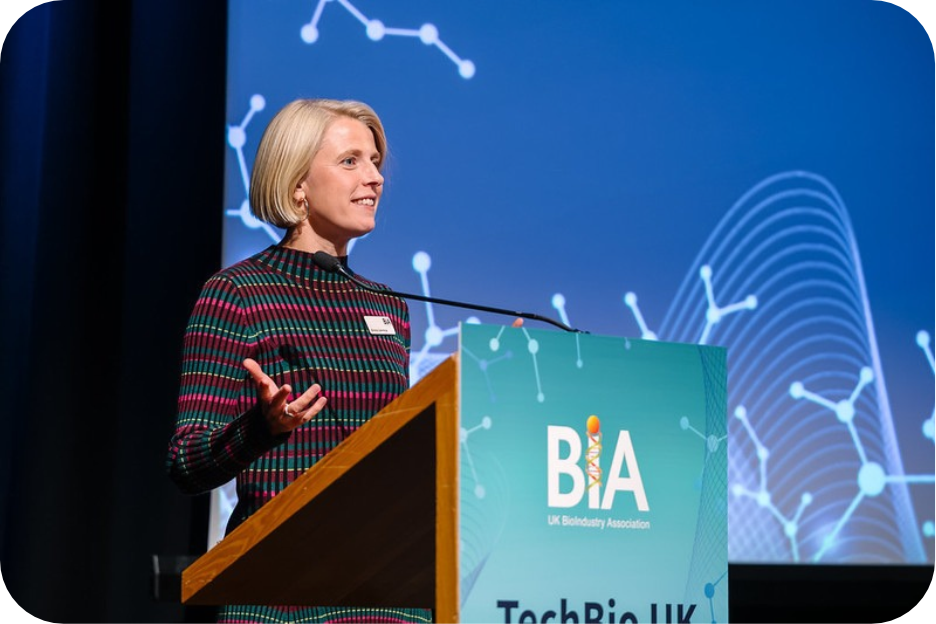
Emma Lawrence, Head of Data Tech Policy and Public Affairs at BIA, presenting at TechBio UK 2026
BIA’s Corporate members heard from Emma Lawrence, BIA’s Head of Data Tech Policy and Public Affairs, on the work we have been doing around access to health data. Members attending the session discussed what data their companies use and if it’s ready for AI.
Participants reflected on a history of inconsistent data collection and curation, noting the huge amount of funding and resources necessary to correct this. Nonetheless, the solution emerged as maintaining AI as a central consideration for ongoing data collection and celebrating the small wins in “correcting” the past.
Getting good quality data
Meanwhile, panellists on the TechBio Investor Breakfast Club, chaired by Leigh Brody, confirmed what many in the sector instinctively know: that the training data must contain what is actually needed.
They elaborated that generating huge amounts of data from lab models that don’t predict what happens in patients just produces more false positives. Panellists agreed good-quality data needs to be defined, and the conference’s sessions brought the sector closer to that prospect.
Better disease models are the prize, they stated. AI combined with powerful experiments could make lab models that reflect human disease much easier to build.
But AI isn’t magic, they stressed, and the hardest test in drug discovery is still whether a drug works in people.
How the UK can convert its TechBio potential into global impact
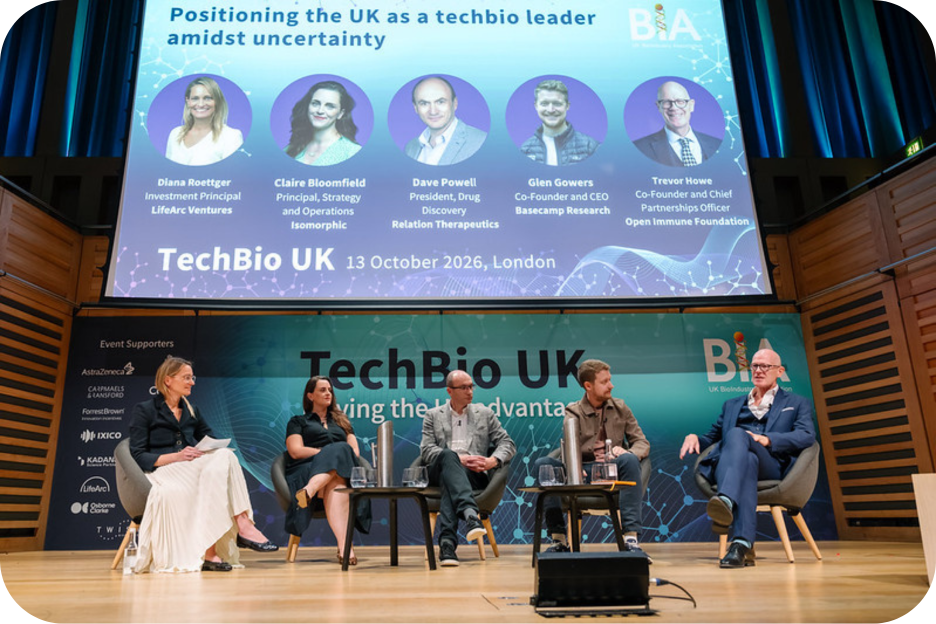
Positioning the UK as a techbio leader amidst uncertainty panel at TechBio UK 2026
And the conference didn’t stop at asking what businesses can do to accelerate their groundbreaking research. The environment companies find themselves in was also at the heart of the conversation.
Diana Roettger, Investment Principal at LifeArc Ventures, asked the question: is the UK converting its TechBio potential into leading global companies?
Claire Bloomfield, Principal, Strategy and Operations at Isomorphic Labs, argued:
There is so much potential in our health data and we are yet to capitalise on it. We could be much better at the integration of the various ingredients at our disposal.
Panellists noted the ambition from government, but that joining various elements together has been a struggle, including connecting datasets from a financially stretched NHS.
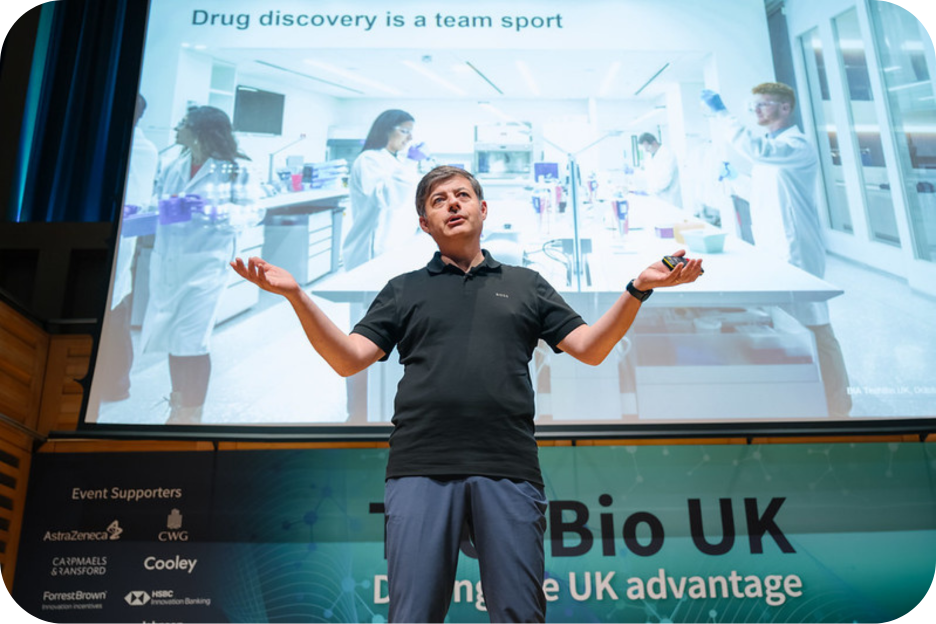
Philippe Marc, Chief of Staff and Head Data & Digital Office at Novartis, delivering the closing keynote at TechBio UK 2026
Philippe Marc, Chief of Staff and Head Data & Digital Office at Novartis, rounded off the day with a concluding keynote on the potential of AI to cure disease.
He outlined his hopes that “most” diseases could be cured with the help of AI in the next 10 years.
Central to this ambition is to collect data, urging everyone in the room and the industry at large to produce more data.
There are reasons to be hopeful. We are producing data at faster rates than we ever had – and we have the AI to read it.
Thanks again to our event supporters: AstraZeneca, CWG, Cooley, ForrestBrown, HSBC Innovation Banking, Johnson & Johnson, Kadans Science Partner, LifeArc, Nxera Pharma, Osborne Clarke and IXICO.
We hope guests left with food for thought, new connections and a sense of optimism.